Distributed Agents Are What Make AI Systems Work Like Organizations
The next step past the single model loop is many agents, each addressable by name, carrying its own state, and coordinating through explicit messages.
Most agent frameworks today start from the same basic shape: a model, a prompt, a set of tools, and a loop. That shape has carried the field a remarkably long way, giving us coding agents, research agents, workflow agents, tool-using assistants, and steadily better harnesses wrapped around the underlying LLMs. The next architectural shift already feels close, and everything about it points toward distributed agents.
What I mean by distributed has little to do with the narrow infrastructure question of running something across multiple machines, and everything to do with the systems sense of the word: many addressable agents, each carrying its own role, state, memory, tools, permissions, and lifecycle, coordinating through explicit communication. That is the direction production AI systems are already moving in.
Agent harnesses were the first step
The first wave of agent infrastructure focused almost entirely on the harness, and for good reason. A raw model needed a great deal of help around it: tools, structured outputs, retries, memory, planning, tracing, handoffs, and guardrails, and the harness became the layer that turned a single model call into something that could actually act in the world, which for a while was exactly enough. Anthropic’s guide to building effective agents captures this single-agent-plus-tools era about as well as anything written so far.
A good harness gives the model a controlled environment, defining which tools are available, how the model calls them, how results come back, when the loop continues and when it stops, and how developers see what happened along the way.
The single-harness model runs into a ceiling, though, the moment an agent starts doing real work, because at that point the problem is no longer about one model loop at all. The surrounding system has to coordinate several kinds of work at the same time:
- background tasks
- long-running workflows
- human review
- specialist agents
- deterministic services
- memory updates
- stateful user context
- parallel investigation
- compliance checks
- retries and recovery
- cross-environment execution
The harness still matters once you reach this point, but it has stopped being the whole of the architecture, which raises a question most frameworks never quite answer: what runtime sits underneath the harness?
Why distributed agents matter
Most serious agent workflows are not naturally single-threaded conversations; they look far more like systems of work.
A top-level assistant receives a user request and immediately asks one agent to retrieve context, another to evaluate risk, another to check policy, another to summarize the findings, and another to wait for human approval. Some of that work runs immediately, some of it runs in the background, some of it needs to resume tomorrow, and some of it needs to run close to a data source under far stricter permissions than the top-level agent should ever be allowed to hold.
Forcing all of that into a single agent loop produces a fragile architecture that fights you at every turn, whereas distributed agents give you a model that bends with the shape of the work instead of against it.
In that model each agent holds a stable identity, owns its own state, and exposes a narrow set of capabilities, and it can run locally, inside a worker, in a sandbox, or out in the cloud without changing how anyone talks to it. The top-level agent stays free of every implementation detail and only has to know how to send work and receive results back, which turns out to be a far more natural way to build complex systems than threading everything through one process.
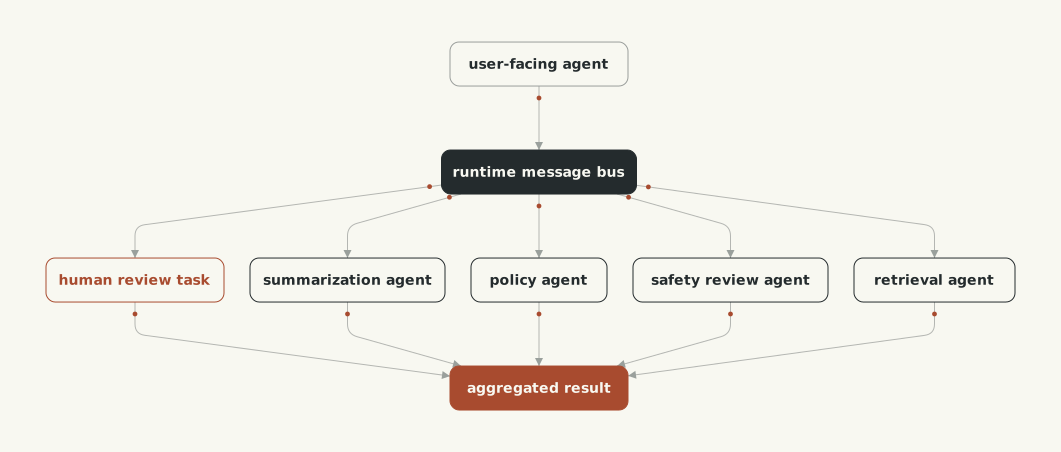
Figure 1. A user-facing agent fans work out to specialist agents and a human review task through the runtime, then aggregates the results.
Agents graduate into addressable participants in a system, each one a first-class member of the architecture rather than a nested loop within a single process.
Addressable agents are the core primitive
The key idea reaches past the obvious point that agents can run in different places and lands on something more durable: agents can carry stable, long-lived identities of their own.
An addressable agent might live locally, on a cloud worker, in a sandbox, or in a paused state waiting to be resumed later, and it might be backed by a model, a deterministic workflow, a human review queue, or some mixture of all three. The caller never has to know which of these is true, because it simply sends work to an address and lets the runtime resolve where that agent lives, deliver the work, preserve the relevant state, and return or record an outcome.
That changes the programming model, because instead of treating agents as throwaway objects spun up inside one loop, you begin treating them as members of an organization with real standing. Each one carries:
- an identity
- a scope of work
- instructions
- permissions
- tools
- state
- deliverables
- a lifecycle
- a place in the broader system
This mirrors how real organizations actually work, because a company has never been one person thinking through every task on their own; it is a hierarchy of people and teams, each with their own responsibilities, memory, delegated work, handoffs, and review paths, and agent systems are steadily growing into the very same shape that distributed computing settled on decades ago with the actor model, where independent processes hold their own state and coordinate purely by passing messages.
Picture an entire autonomous organization encoded as a hierarchy of agents and deployed into the cloud, where work arrives as a human request in a UI, an external event, or a schedule, or where the whole thing is kicked off once and then simply keeps running in the background with very little human involvement at all.
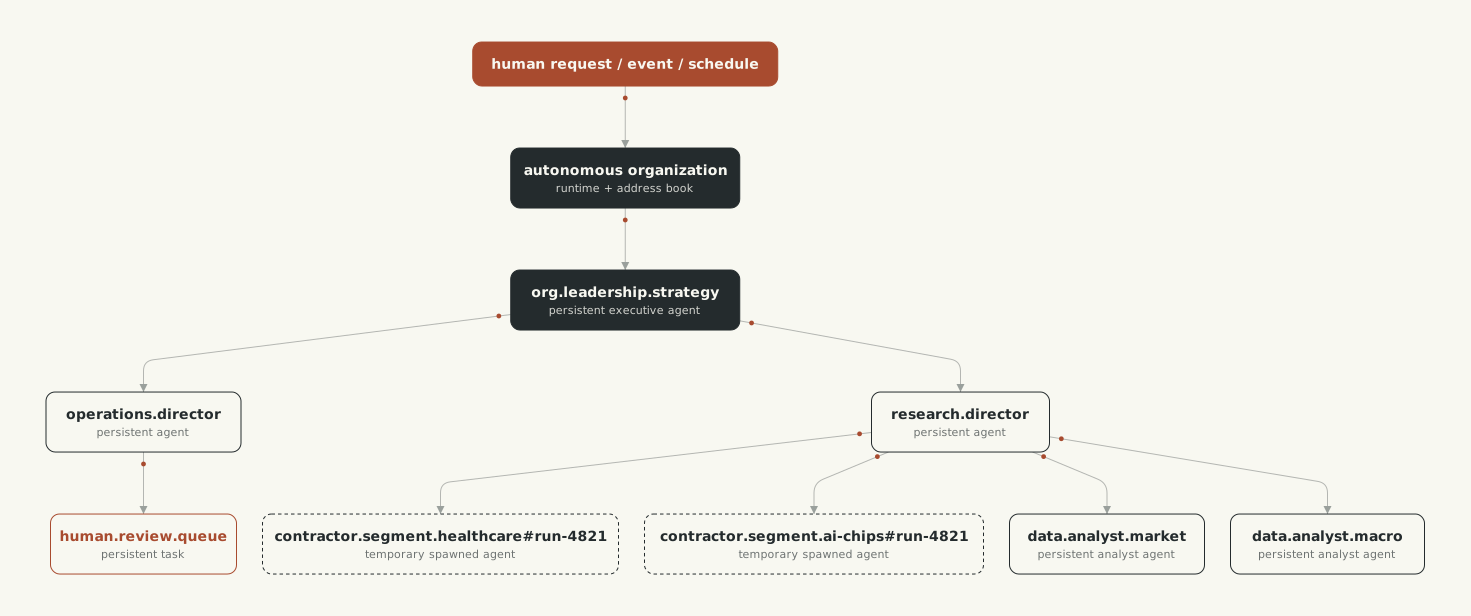
Figure 2. An autonomous organization as a hierarchy of agents: a persistent executive delegates to directors, who own persistent analysts and spawn temporary contractors.
Some agents behave like durable employees, holding stable addresses, persistent memory, and long-running responsibilities: a research director agent takes work from several analysts over time, a compliance agent fields approval requests flowing in from many workflows, and a primary care agent sends patient labs to a specialist for review.
Other agents behave more like temporary contractors, as when a senior analyst notices that a market analysis splits cleanly into independent parts, spawns ten short-lived agents with one per market segment, collects their findings, and lets them dissolve once the work is done. This is the same parallel pattern Anthropic described in its own multi-agent research system, where a lead agent spins up several subagents to investigate at once and then folds their results back together.
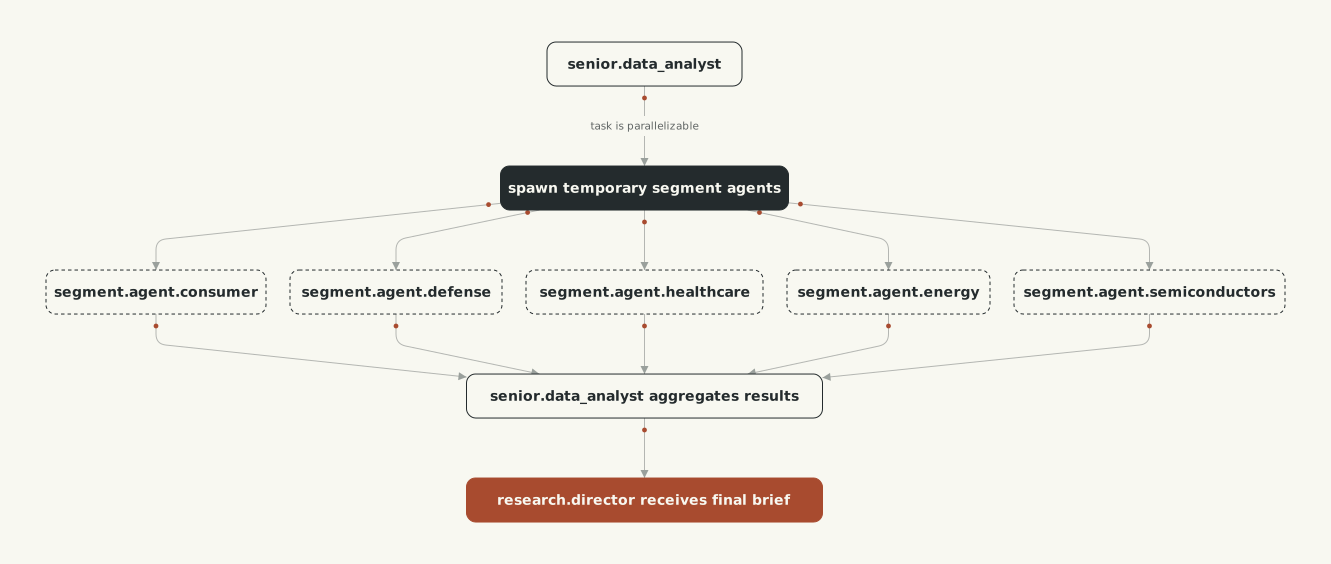
Figure 3. A senior analyst splits a parallelizable task across temporary segment agents, then aggregates their findings into a single brief.
The distinction is an entirely practical one: a temporary agent fits whenever the system needs parallel thinking or a burst of short-lived specialization, while a persistent addressable agent fits whenever it needs continuity, memory, ownership, accountability, and delivery it can stand behind later.
Healthcare makes the point concrete. A primary care agent sends a patient’s labs to a specialist review agent, and that specialist needs a durable identity precisely because the review may later have to be audited, resumed, escalated, or referenced, all of which matters enormously in a compliance-heavy domain.
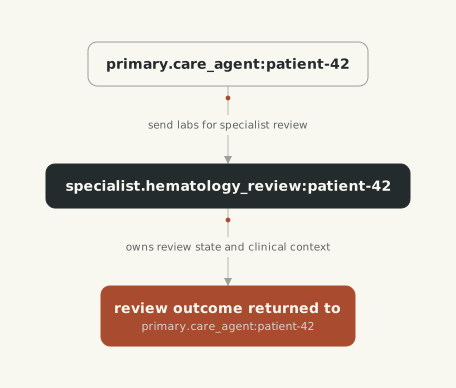
Figure 4. A primary care agent hands patient labs to a durable specialist review agent, which owns the clinical context and returns an outcome.
Research tells the same story. A director of research absorbs findings from analysts spread across many projects, and recreating that director as a throwaway sub-loop every time someone needs a report would throw away exactly the memory and judgment that make the role worth anything, so it should instead be a stable, addressable participant with its own memory, standards, and deliverables.
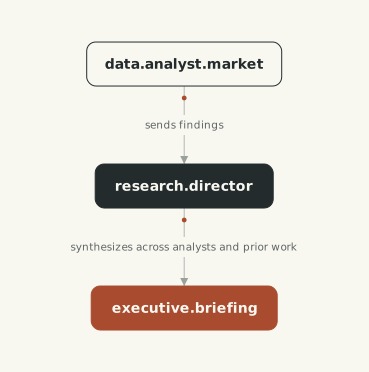
Figure 5. A market analyst sends findings to a persistent research director, which synthesizes across analysts and prior work into an executive briefing.
This is exactly what makes addressable agents so powerful: you delegate to an agent based on what it is responsible for, rather than on knowing which process it happens to be running inside at the moment.
The runtime owns delivery, routing, state, and outcomes; the agent owns its role; the caller owns the intent. That clean separation of ownership is what gives distributed agents the feel of an operating model for work rather than just infrastructure entities.
The local-to-distributed path is critical
Even though the destination is distributed, the starting point still has to stay simple, which is why most teams should begin not with a distributed system at all but with a single local agent and a clean development loop they can iterate on quickly.
The trouble is that many frameworks make local and distributed feel like two entirely different worlds, and the distributed world often arrives with a heavy vendor-lock side effect attached. You start with a simple harness, the workflow grows, and suddenly you need background workers, queues, pub/sub, stateful recipients, and multi-process execution all at once, at which point the original agent abstraction no longer fits and you find yourself bolting infrastructure onto the side until complexity is leaking out of every seam. The far better path is to use the same communication model from the very start.
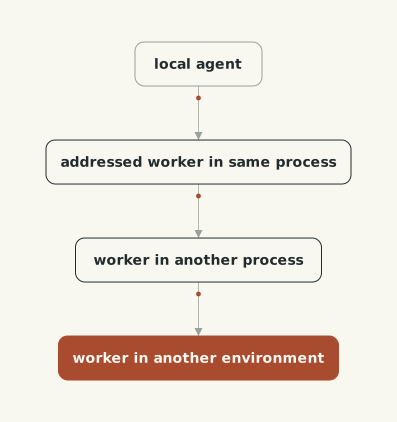
Figure 6. The same communication model holds as a local agent grows into workers in other processes and environments — the execution topology moves while the addressing stays constant.
The execution topology shifts underneath you while the communication model stays exactly the same, and this is one of the most important ideas behind distributed agents: distribution should arrive as an evolution of the system you already have, never as a rewrite of it.
State belongs to agents, not just conversations
State is another reason the distributed picture matters so much, because a lot of current infrastructure treats state as nothing more than conversation history, which is genuinely useful and also badly incomplete.
Real systems carry several kinds of state at once:
- conversation state
- task state
- user state
- worker state
- memory state
- review state
- tool state
- retry state
- audit state
None of this belongs in a single place. The top-level assistant holds the conversation context, specialist agents own their working state, deterministic services manage their own internals, and long-running workflows need state that survives process restarts entirely, while some state should never reach the model at all.
Distributed agents make all of this far easier to reason about, because state attaches to the agent or task that owns it:
- a clinical review agent owns review state
- a personalization agent owns user preferences
- a memory agent owns retrieval and update policy
- a human-review task owns approval state
That alone keeps the top-level agent from swelling into an over-engineered monolith responsible for every concern in the system at once.
Human review fits naturally into distributed systems
Human-in-the-loop workflows usually get discussed as a feature of the agent, when architecturally human review is really a distributed systems problem in its own right.
A review step pauses execution, runs in a separate UI, and needs notifications, audit trails, and role-based permissions, and it might resume in minutes, in hours, or only days later, none of which fits cleanly inside a single synchronous model loop and all of which fits comfortably as an addressable task living in a runtime.
The agent sends work to a human-review task, and that task persists its own state, waits patiently for input (could be days), and publishes a result back once a person has finally weighed in.
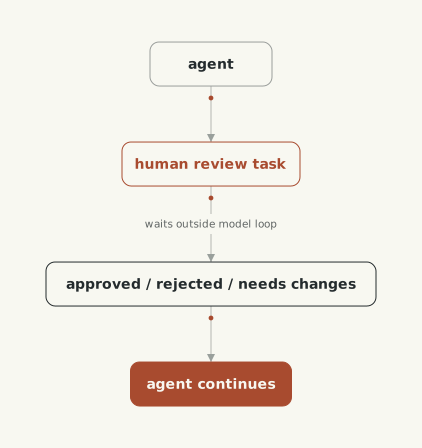
Figure 7. Human review as an addressable task: it waits outside the model loop until a person approves, rejects, or requests changes, then the agent resumes.
In healthcare, finance, legal, security, and operations, human review is simply part of the system design, and the architecture has to reflect that from the beginning.
Distributed agents improve inspectability
The more capable agents become, the more inspectability matters, because the moment a system produces a result, someone needs to understand how it actually got there.
In a monolithic agent loop everything collapses into one long, undifferentiated trace of prompts, tool calls, sub-agent calls, memory updates, retries, partial failures, and a final output, and a trace shaped like that tells you very little about the architecture that produced it.
Distributed agents give the system far clearer boundaries:
- this agent received the task
- this worker executed it
- this state was reused
- this message was sent
- this publish fanned out to these recipients
- this result came back from this specialist
- this human approved this step
That structure makes debugging easier and it makes product behavior far easier to explain.
As agents take on more responsibility inside production systems, users and operators start asking far harder questions, and answering them with “the model did it somewhere inside the loop” stops being acceptable, so the answer has to be inspectable.
The harness still matters
The harness is still the layer where model behavior gets defined: prompts, tools, handoffs, streaming, structured outputs, model-facing policies, skills, memory surfaces, and safety limits.
The harness should not also have to be the distributed systems layer, because that is simply too much weight for one abstraction to carry on its own. A better architecture separates the concerns.
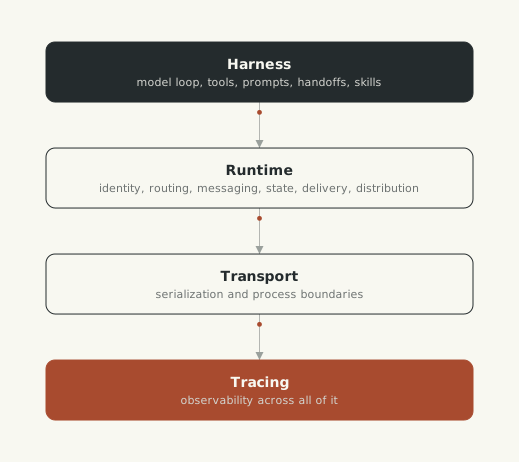
Figure 8. Separating concerns across layers: the harness shapes model behavior, the runtime coordinates, the transport crosses boundaries, and tracing spans all of it.
Once those layers are separate, each one can improve without distorting the others: the harness focuses on model interaction, the runtime on coordination, the transport on crossing process and environment boundaries, and tracing ties the whole path together.
It is the very same separation that made networked software reliable, and there is a deep well of established patterns to borrow from here. You would never build TCP retries into your application logic or bundle your HTTP server into your database, because the layers exist precisely because the concerns really are different, and agent systems have now arrived at the same point and inherit the same separation.
Where AgentLane fits
AgentLane started as a weekend project and turned into part of how we build agent systems at Diadia, especially for the complex healthcare workflows where reliability and inspectability are never optional.
It came out of a simple observation: we needed far more control over how agents actually run. We wanted agents addressable across environments, execution that could move from local development out to distributed workers without rewriting the top-level harness, and a system where state, memory, personalization, skills, tools, and human review all composed together instead of locking us into a single execution model, with everything still inspectable after the fact.
AgentLane stays deliberately unopinionated about model intelligence, so you can plug in the OpenAI Agents SDK, Claude-based agents, local models, open-source models, paid frontier models, or your own hand-rolled LLM loops, and you can just as easily build agents that are not model-first at all, including deterministic workflows, human review tasks, data processors, and hybrid services that summarize their output before handing it to the next agent.
AgentLane provides the rails those agents run on and talk through. At the runtime level that means addressable agents, message passing, delivery outcomes, persistent state, resumable execution, pub/sub, and distributed workers. On top of that sit the harness-level pieces you need for practical agents: model loops, tools, handoffs, streaming, shims, skills, memory seams, and human-in-the-loop patterns.
The goal throughout is to let the local version grow into the distributed version without ever changing the foundation underneath it, so the same communication model, the same addressing scheme, and the same mental model for state and routing all carry across while only the topology moves and the core stays put.
A few things make this matter right now. AgentLane is open source and extensible, with no ties to a single vendor, model family, or harness style. It stays independent of any particular execution environment, so the same topology runs locally, in cloud workers, in sandboxes, or in a hybrid setup where some agents sit close to sensitive data while others run in managed infrastructure. Addressability makes it genuinely easy to bootstrap autonomous organizations, since you define a hierarchy of agents, give each one a role and an identity, deploy the topology, and let work move through the system as messages rather than as hard-coded function calls. And the architecture holds up in high-stakes environments, because real work in healthcare, finance, security, legal, and operations asks for delivery semantics, state ownership, auditability, review paths, and clear operational boundaries.
We have been running AgentLane in production on healthcare workflows where a single dropped message or an unresolvable agent state can turn into a problem with real consequences, and that constraint shaped every design decision we made.
The direction of the field
The next generation of agent infrastructure is going to look far less like a collection of isolated assistants and far more like agent operating environments, something close to operating systems, with clear boundaries and well-defined responsibilities.
Agents will run in the background, coordinate with one another, specialize, own their state, draw on memory and skills, and turn to humans for review, moving freely between local, worker, and cloud environments while needing to be restarted, resumed, audited, and improved over time.
Teams building serious AI products are already arriving at this conclusion on their own, because the moment you move from a demo to a production workflow with real users, real data, and real consequences, the single-loop model begins to crack under a load its architecture was simply never built to carry, even when the underlying model is performing perfectly well.
The teams that get this right will build systems that outlive the demo and stay reliable enough to run in the background of real products for real users, the kind of system you can inspect, explain, and trust without crossing your fingers.
That is the future AgentLane is built for.
If you are building something in this space, the repo lives at github.com/yasik/agentlane; it is early and very much meant to be extended, and I would like to see what people build on top of these primitives.